Tania de Jong
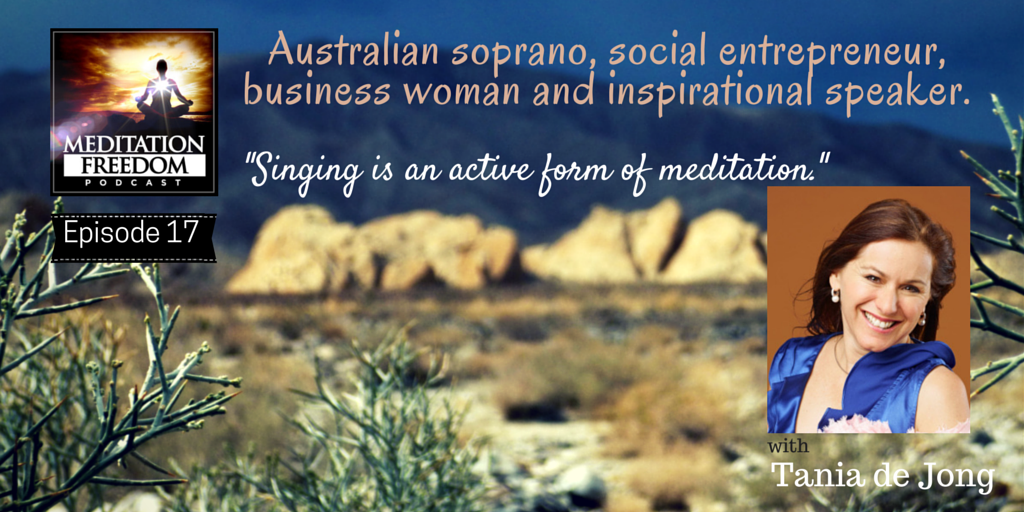
Tania de Jong AM is a leading Australian soprano, inspirational speaker, social entrepreneur, spiritual journeywoman and creative innovation catalyst. She founded Creative Universe, Creativity Australia, Music Theatre Australia, Pot-Pour…
Tania de Jong AM is a leading Australian soprano, inspirational speaker, social entrepreneur, spiritual journeywoman and creative innovation catalyst. She founded Creative Universe, Creativity Australia, Music Theatre Australia, Pot-Pourri and The Song Room and works with diverse communities through the ‘With One Voice’ choir social inclusion programs. Tania sings around the world as a soloist and with her group Pot-Pourri releasing 7 CDs. She is Founder and Executive Producer of Creative Innovation Global.
Tania’s TED Talk How Singing Together Changes The Brain has sparked international interest (see Youtube video embedded below). Tania has recently released her solo CD Heaven on Earth.
This is a summary (not a full transcript) of the interview
How did you get started with a meditation practice?
Tania: Yeah, I started with TM, wasn’t very disciplined at it. For me, singing became my meditation.
Singing is an active form of meditation.
When you sing you have no choice but to be totally in the moment.
You have to be conscious of your breath, and you can’t be thinking about anything else. Your body is an instrument. To actually sing sustained sound, you have to keep your breath going. Its’ similar to meditation, having an even exhalation breath, that’s what the sounds sits on.
If you practice hissing, you get a sense of what happens. You need to keep the air flow going.
Did meditation help you with singing?
Tania: Yoga helped as a more active form of meditation. Its hard to sit and meditate.
Sicco: Chanting is a kind of singing meditation in my Zen meditation. Letting my breath sink, use your whole body as an instrument, instead of just the top.
Tania: Yes, changing and singing correctly engages your whole body right. Through mother earth you bring the sound of the earth. Tania feels like she’s breathing all the way from her feet and up. She feels this incredible energy sphere around her body.
Many have trouble unlocking the full potential of their voice. Many folks think of their voice as just above their neck and up. My voice is my voice box. When you do that, You fail to engage the resonating cavities that are in their bodies. Your body is like a resonating instrument. There’s resonators in your chest cavities. Resonate right through your head. Their upper amplifiers.
A lot of people have a very tight jaw, which is another issue that keeps you from from using the full capability of your voice. When you chant or sing, in that passioned way, you start to relax your jaw as well, which allows you to access those resonators more.
You mentioned clenched jaw, there’s psychological boundaries to get through as well.
Yes, it’s all about letting go. The root of your tongue can get hard too. There are certain exercises you can do to gradually release the jaw, let the jaw relax at night. It’s also about letting go of control. When we’re holding on to issues, wanting control. Instead of Practicing acceptance, we get tight with our jaw, or when we’re afraid. Relaxing that jaw hinge is extremely important. The TMJ (“Temporomandibular Joint”).
Are there other parts of the boy that need to relax as well in order to fully express your voice?
Yes, some folks lift their shoulders up, only breathing in the upper part of their chest cavity. Heave of their chest, you have to learn to breathe at the base of your ribs. I liken it to blowing up a balloon inside your stomach. You blow it up and it is all the way around 360 degrees. When you breathe in your upper part of your chest, that is a stress response, its a fear and panic response. That also induces a relaxation response.
So it helps people with anxiety problems too?
Singing would have to be one of the best ways to heal anxiety and depression that I know of. A lot of people suffer from depression and anxiety. Many people have stopped taking drugs. Singing is the greatest drug of all. Very good for you, a bit addictive perhaps.
Singing is like exercise for your brain, body, mind, and soul. A super duper drug!
And you mention it takes you out of the box thinking?
Yeah, so basically our brain is like a battery, and the right side of the brain, which is our creative intuitive side, is like a charger. But we spend a lot of time, especially in today’s world, analyzing data, overwhelmed with so much information. 85% spend time on the left side of our brain.
So it is very important to spend time doing activities which recharge the right side of the brain so we don’t get burned out, stressed, depressed. One is singing, meditation walking in nature, walking with pets, cuddling with loved ones. Being creative in other ways, all extremely important ways to recharge your mental batteries.
Often times people with depression are not doing enough of those sorts of activities.
And society is also having productivity and bottom line expectations.
But actually organizations will have a much better and achieve their goals, bottom-line if they allowed to recharge their right sides of their brains. Helps with productivity, positive about the future. Whereas stress about the bottom line is unhealthy driven pattern.
That is one of the reasons why there is an increase of anxiety and depression. Mental health issues arising all over the world. Depression is one of the main chronic illnesses of the western world.
…
You mention uncovering your one voice and your unique voice.
With our one voice we bring together many individuals, job seekers, and others who are struggling in their lives. We bring together all these diverse people, these diverse voices.
We all suffer the same fears, same hopes, we’re all connected, part of this universal consciousness.
There’s something really special when you sing together with other people. Some of the research shows that our hearts start to beat together, when we sing together.
There is this connectedness.
Your creativity sparks when you’re with a diverse people. Most people tend hang around similar people. Dress, talk the same, similar education, etc. I believe that we can get more of our human potential, if we connect with people who are very different from us. We learn a lot from being with people who are very different from us. It sparks our creativity.
Getting out of our own comfort zone is the best way to unlock our own creativity and your unique voice. Otherwise you’re in the box.
We start life being born in a box, then we go home to a house, another box, in the supermarket we buy boxes of stuff, same boxes. We tick boxes on forms, and then we go out of life in a box. I have this theory that, life happens between the boxes.
On the bridges where we connect with other people, with a larger universe.
So to connect with that, you have to get out of your comfort zone.
How do you encourage that?
The biggest way to get out of your boxes, is to connect with other people. Befriend an alien! Sit down next to someone you don’t know. Don’t just hang out with the people you know. You may actually find out you share something, there might be synergies between you.
Look for new experiences. If something really scares you, go and try it. There are a lot of people who are very scared of singing. and public speaking (Glossophobia – Public Speaking). 74% have speaking anxiety, includes extroverts (Source: National Institute of Mental Health). 85% of people have been told at some point in their lives that they can’t sing, their parents, schools, etc. That is why a lot of people have a fear of it. Been told they’re not good enough.
That would never happen in parts of Africa. All tribes sing together, sing in harmony. Singing is a tribal and primal activity. It is only in our western world where there’s such a culture of celebrity. We start judging ourselves.
I was told as a 4 year old, never to bother to have singing lessons. If I believed that, I would not be sharing that gift with the world today. That would be sad for me, and those who enjoy listening to me.
Every single person was born with a voice to share with the world. Our voices are a reflection of who we are as a human being.Voice is the language of our hearts. Many people who are disadvantaged in their lives, their voices are silenced. Not just their singing voice, but their voice.
People often don’t feel like they can speak up, can’t express themselves. They can’t say what’s truly in their hearts. Going through their lives not being able to do what they truly want to do.
My vision in life is to help people find their true voice. And also to change the world, one voice at a time. Which we’re doing through Creativity Australia. We have this big global campaign, “Sing for Good”. Two or more people pump it up on YouTube, and then getting family to vote and support disadvantaged people.
We talk about self-limiting beliefs, a lot of that comes from childhood. Our caregivers and teachers do their best, but sometimes things are said that shouldn’t be said. The negative sticks more to a child than the positive.
We have a lot of big projects designed to help people find their voice, connect with diverse people, and to connect to their creativity. I tried to de-condition myself from deep childhood conditioning, which created self-limiting beliefs.
Yes, things happen, a lot of self-limiting beliefs come from childhood. We have to be very careful what we say to young people. People do their absolute best to give encouragement and constructive to young people.
I’ve talked to tens of thousands of people who have remembered things that they’ve been told, between ages of 0-15 that they remember for their whole lives which stops them from being who they really are.
This celebrity culture (putting people on pedestals) must be part of the system as well right?
Celebrity culture constantly remind us that we’re just ordinary, just living an ordinary life. When it in actual fact, it is the opposite, every person is actually extraordinary. When you speak to people in our choirs, you realize that every single person is extraordinary.
Tania mentions a person with cerebral palsy. She has such incapacity, and yet every week she comes to the program, happy to be there, laughs all the time, she found a job through it. She knows all the songs and the words by heart. Every week she comes there to the choir, and if I’m having a grumpy day, Beth teaches me and all of us about gratitude. It’s just the luck of the draw where we’re born, and our conditions. Are you going to take things for granted, or are you going to live with gratitude? And she is so grateful herself, despite her conditions and adversity.
Truckhaven Rocks with heavy storm clouds behind on the Santa Rosa Mountains
Talk about what inspired you to create the song, “Heaven on Earth”.
I wanted to connect that higher consciousness that we all have, to earth. To create a CD that would take people to a heavenly space, meditation, a space of reflection and illumination. Songs of love, that would help people feel more light, and love and peace.
Some is music by Mozart, Beethoven, and Dvorgak, timeless classic orchestral works, and then there’s also some original work. Like the title track.
Starts with Mark Twain’s beautiful quote,
“Sing like no one is listening, love like you’ve never been hurt, dance like no one is watching, and live like it is heaven on earth.”
I do belief that people need to sing like no one is listening. It’s just come out (see link to music below, and this is played in the podcast as well).
We all have our daily issues, the humdrum of life, but how do we get to experience the glory of life? It’s so incredible to be alive. And looking in nature is a great way to connect with life, for connecting with the right side of the brain. Like looking and smelling a rose.
And they teach us to be here without needing an excuse or justification and unique. Yes, flowers and animals don’t have that judgement that humans feel. Yes, dogs don’t make value judgments, they’re unconditionally loving. How do we as human beings can get more into that space? Of non-judgement, acceptance, love peace, letting go. So that we can truly experience our lives in every moment.
Do you have any tips for someone who wants to be more in that space?
The key is you have to reserve a little time every day, that is your time, where you do something you love, something that gives you a gift.
It could be a beautiful bath, music, or going for a walk, like by the ocean.
Singing, meditating,
Breathing, becoming aware of your breathing in each moment.
Letting go of the past, and any anxiety for the future.
The only moment we can really have any control over, is this exact moment. That’s all there is.
What would I do if my life were to end today or next month, what would I do with my life? Start doing those things.
The rest of your life starts now.
My favorite quote,
By Rabi Hillel says,
“If I am not for myself, who will be for me? But if I am only for myself, who am I? If not now, when?” Ethics of the Fathers, 1:14
I encourage everyone to not put off any longer doing the things you really love to do. Especially singing. Find your voice!
Tom is a dedicated long-time Ashtanga Yoga, Pranayama and Meditation practitioner. He is a passionate Yoga teacher, inspiring Yoga business & life coach, and whole-food & healthy-living enthusiast, based in Germany.
As a Yoga teacher, Tom believes in the benefits of learning yoga through the Mysore style self-practice classes. He encourages students to develop their personal practice rooted in the Mysore tradition yet incorporating their individual needs.p
Tom studied with many senior Ashtanga Yoga teachers and is grateful for the guidance by his primary teacher Paul Dallaghan, who also initiated him in Pranayama practices in the lineage of the Kaivalyadhama Institute.
He mainly leads a traditional Mysore program and Ashtanga Intensives at GaiaYoga School & Shala in Croatia as well as at phoenixarising, a school for Yoga and consciousness practices in Dresden, Germany, and together with his partner Sandra teaches yoga retreats in India.
As a coach, through applying the principles of Yoga, as well as his experience in business and management, Tom supports and inspires Yoga teachers to become aware of their unique gifts and how to share them successfully with the world. In workshops, online programs and one-on-one-coaching sessions, he offers tools and techniques to aspiring Yoga teachers and practitioners to help them get started and/or stay focused in walking their yoga path while supporting the growth of others through their teachings.
This is a summary (not a full transcript) of the interview
How did you end up on a path of Yoga Meditation?
Tom’s brothers both did Yoga, so he got into Yoga based on his brother’s interest of Ashtangha Vinyasa Yoga, and he also broke up with his girlfriend. He was inspired by David Swensen, a well known Yoga teacher.
He started doing this every day. Because of the emphasis on deep breathing, it makes you go deeper into the practice. He got more into it by reading books about it and started practicing it deeper.
In Ashtangha Vineyasa Yoga (breath aligned yoga) Every movement is aligned to your in-breath and exhalation. There’s never a movement without breath happening.
When you follow those 3 techniques, Ujjayi, Trishti, Bandha, that creates a kind of moving meditation.
For many people starting with sitting meditation is hard. With Ashtangha you go more steps before that. Maybe it is easy to connect, but it is easier to use the body, so by moving the body, you have something to do.
If you keep those 3 things in mind, you don’t have more capacity to think. And that creates this moving meditation.
Additionally you always have the same sequence of postures. You just do the same sequence ideally 6 days a week. This Yoga practice creates kind of a mirror every day where you can see the changes over time. Some days are easy, some days not, some days focused, never the same. But a good reflection that everything is changing, and you just have to accept that.
What changes have you notice over the years from your practice?
Tom got a lot more:
Calmer
More aware what he’s doing from waking to going to bed
More in tune how he feels , what is beneficial and what is not so beneficial, due to this mirror of practice. For example, if you fold yourself in a pretzel position, you will feel it if you had something unwholesome to eat the night before.
If you do constantly something else, like different asana sequences, or different sports, you always have something to distract yourself.
If you always practice the same sequence, you really start to appreciate more detail. You start to feel, because it is always the same, you can see where your resistances or emotional distractions are. You can then relate that to your life, like an argument with your friend, or boss. Instead of letting your emotions take over, you can see more from an observer perspective. You notice it, and then you can stop it, and look inside, there’s a longer response time, a witnessing component to it.
Tom talks about the corpse pose. Good ideas come for Tom from the corpse pose. On a spiritual level there’s a little dying every day. You do your practice, you lie down, and your body lies down. And you let go of your body every day just for a moment.
So it helps you not over-identify with your body?
Yes, it feels like a little detachment of the body. That’s how I feel. All the good ideas (like for his business) often come from that corpse pose.
14:00- 16:00 How did you go deeper into yoga, like reading Patanjali Sutras?
Yes, he started reading and studying more and more, and going to India, and so then all those aspects got more and more integrated. He didn’t think he would go that deep 10 years ago. Slowly through the physical practice it opened him up. And there are also other books, like “Awaken the Mind“. It talks about the brainwave patterns, and also about meditation. It has a more scientific approach, putting the spiritual practices into a more explainable to a rational western mind. He also knows how it feels from his own perspective, and now he can also explain it.
Patanjali’s 8 limbs, Ashtangha Yoga, these 8 steps lead to Samadhi (liberation, divine bliss, experience of oneness state)
8. Samadhi : Union with the Divine
7.Dhyana Meditation is the 7th limb.
6.Dharana You need concentration to get to that, that’s the 6th limb. How do you get to concentration?
5.Pratyahara (control of the senses) Well, you need to keep from getting distracted senses, so withdrawel of the senses is the 5th limb.
4.Pranayama (energy, breath control) Attention goes where the breath goes, the 4th limb is control of your breath energy. without that you will be unfocused. So breath control is that 4th limb. How to control your breath?
3.Asanas (Body Postures) You have to control your body, so that’s the 3rd limb, the Asanas and postures (which means a seat that is stable yet comfortable). You need all these ingredients
2.Yama (Universal Morality) The second and first limb are the Yamas..
1.Niyama, the do’s and don’ts the morality, be disciplined, be content, those are kind of the foundations.
All those limbs, you can practice at once, it’s not a consecutive thing. You don’t have to perfect one step to go to the next. The Asana part is to get your body healthy. Your gazing point should always be concentrated on one spot. When you combine all those things, you create this meditation in movement.
You should make sure you don’t do a posture that hurts yourself. I love this philosophical approach to this physical aspects.
Would you say that most folks would get introduced to Yoga through the Asana limb?
Yes, we have a hard time relating to the subtle thing, if you don’t have any relationship to that in your normal lives. Just sitting and doing nothing and focusing on the divine, many can not relate to that in their normal lives. While standing on a yoga mat, and learning to breathe, you get a more gradual introduction to the more spiritual aspects.
We’ve talked about the importance of the Asanas, and how they are a form of meditation themselves. Does this in a way lead the practitioner to seated meditation?
With regards to Asana Yoga:
“This limb of yoga practice reattaches us to our body. In reattaching ourselves to our bodies we reattach ourselves to the responsibility of living a life guided by the undeniable wisdom of our body.”
But Tom cautions against getting too stuck on the body, you should start a relationship with your body, if it has gotten lost. Meditation for Tom is a state that you cannot just switch on. There are many techniques, like mantras, that invite us to get into a state.
Is this limb and other limbs often divorced or uncoupled from the Yoga that has been brought in to the west?
Or do folks after doing Asana yoga naturally gravitate towards learning more about meditation and the other limbs?
When Tom was working in a consulting firm, he just practiced in the hotel rooms. So you have no excuse not to practice.
But some folks stop practicing because they forget. Yes, for me what kept me practicing day after day, is that I miss it if I don’t do it. There are of course also other motivations to keep practicing.
But the main part, is the way I feel when I practice. It feels good, that is one motivation that keeps you going. I can’t tell folks to practice though. It’s really up to the individual.
There’s also no finish line right, always a beginner, not like a certificate at the end? Which helps you get into the present?
Yes, it’s tricky. Some folks can get attached to the practice. But there are fewer and fewer people who finish the harder sequences. So there’s always a new Asana that you can learn, but there will always be a harder one after this next Asana cross road. You shouldn’t attach your happiness to a certain result or the fruits of your practice.
The path was the goal all along. You just have to love every moment, find your happiness on the path, love the present moment.
Advice for folks just starting out with Yoga?
Find a good teacher that’s helpful, someone give guidance at least at the beginning.
Just do it, don’t worry about the benefits, don’t worry in general of course too.
Try it consistently for a period of time, not just once a week. Or you won’t feel the benefits.
Muscle fever will go away if you do it a few days a week.
“Before you practice the theory is useless, after you have practiced, the theory is obvious.”
So don’t read books too much, just try it, experience it, and go from there..
How do you bring your Yoga into your daily life?
Tom finds Yoga practice a rehearsal for his life. Whatever happens, just keep breathing. That’s what he always does, whenever he has a tough situations, just come back to himself, and just breath for a few moments.
As simple as that sounds, it is super powerful. Whenever you’re in rush traffic, lecture in front of thousands of people. If you feel unease in yourself, just come back to breathing. And go from there.
There are three things in life, things that are your responsibility, think that are other people’s responsibility, and god or the universe’s responsibility.
If it’s raining, or sunshine, that’s god’s responsibility, so no use in getting upset. Then there are thing that are mine, as long as we care for our own responsibility, we can then be much more happier.
So in terms of Yoga, my responsibility is to show up that day and do the best I can do. If my body feels stiff that day, or some other thing gets in the way of my practice. I can deal with it, but look at my own responsibility.
Tom Richter Yoga Instructor and Meditator
Tom is a dedicated long-time Ashtanga Yoga, Pranayama and Meditation practitioner. He is a passionate Yoga teacher, inspiring Yoga business & life coach, and whole-food & healthy-living enthusiast, bas…
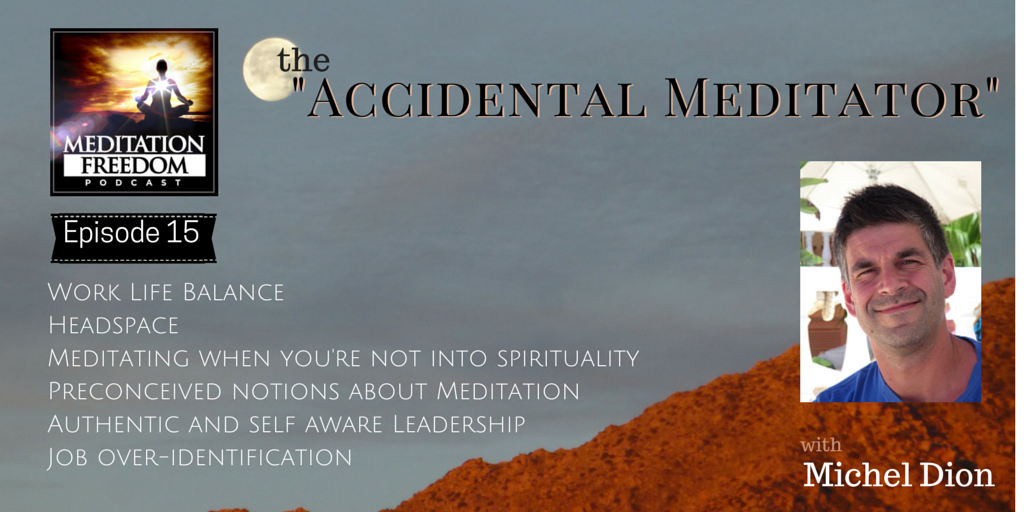
Michel Dion is a CPA and PMP who spent his life in the business world. He has developed a website on project management, called Project-Aria. The name of the website is a mix between his interest for music and project management. He likes to live life fully and passionately. Yet, someone he discovered meditation and the power of the discipline in all dimensions of his life.
Michel also recently published a book called Leadership Toolbox for Project Managers. In the book, he has included the importance of self-awareness and development of the leader as a person as part of leadership skills.
This is a summary (not a full transcript) of the interview
In this podcast we have a conversation about how Michel Dion:
Got started meditating because of too many thoughts and not sleeping much anymore at night.
Michel became an “accidental meditator“.
He is great at solving problems, but it started affecting his family life. He started seeing his friends get burned out by overwork, as well as develop depression. Now in his early 40’s, he couldn’t bounce back from the lack of sleep as much as when he was young.
He was attracted to start meditating after watching a BBC documentary, Michael Mosley’s Horizon: The Truth About Personality (BBC Two) in which Mosley tries mindfulness meditation based on scientific findings about our personalities. And see if he could influence his more pessimistic and insomnia prone personality. He wanted to see if he could change his brain less anxious. They found that the right side of his brain was more active than the left side, which also created an imbalance. A combination of cognitive training and mindfulness training was used to help him change his brain. See, “Can Science Explain Why I’m a Pessimist?“
Michel was inspired by these findings, and also wanted to learn this meditation, so he got the Headspace app by Andy Puddicombe, a former Buddhist monk.
He needed to start with guided meditation. Very useful, otherwise he would have felt lost. He doesn’t consider himself spiritual.
He also noticed more and more projects as he grew in his career, and he was never in the moment any longer. He’d be at work, as well as with his wife, and always thinking either about work or other things. He couldn’t be present any longer. Starting to lose focus.
As a result of a regular meditation practice:
He found that the meditation helped him be more productive at work.
Better and more real connection with his wife and kids.
He found this important enough, that he mentioned meditation, requirement for self-awareness as a leader in the beginning of his book on Business, Project Management, and Leadership, rather than an afterthought. Taking care of yourself.
At the time of this interview..
He still practices regularly using head-space, listens to podcasts (this one, and Tara Brach’s Podcast), and reads about meditation.
Michel is learning how to meditate without the assistance of guided meditation, or apps. He plans on adding unguided meditation to his practice.
Michel had to unlearn some preconceived notions and pressures about what meditation is supposed to be like. Typical misconceptions propagated:
“You can stop all thoughts!”
“Real meditators are always 100% peaceful and happy!” (as though they are no longer human!)
“Multi-Tasking”
Michel was a great “multi-tasker” at one time, but learned that this wasn’t working very well.
He would do other tasks while “listening” to his wife. After realizing this error, he now has a deeper connection and conversation.
Another challenge he has is with long-distance running. At some point his mind is, “no longer in the moment”. It’s not physical pain that’s the problem after 2 hours of running, but his mind. He is going to read the book by “conscious runner” Lisa Hamilton (former guest on this podcast).
How his meditation affects his work, and leadership role?
Very much, as a leader you can be agitated, “do, do, do, more, more!” But people are more likely to follow a leader that is calm. Then a leader that is helps give their team confidence of success. Comfort zone does not mean it’s easy. You get greater results with a team with greater self-awareness.
Authenticity and honesty are often lacking in leadership.
In business you can master something. Michel studied classical music when he was younger and you can master that as well. He feels it’s different with meditation, you can’t say you have 100% self awareness. You can do this for 30 years and you will still discover something, so it’s never completed. There is a level of being comfortable in the unknown.
Michel talks about developing more knowledge of the self, which is part of executive leadership development program. Meditation and modern science is bringing it to the western world from a different angle.
We discuss how meditation is sexy or trendy, and the potential issue if the leadership and executives don’t practice meditation themselves, and use it to squeeze more productivity out of employees, or put them into smaller cubicles to save money, without thinking of the triple bottom line.
Michel talks about the blind spot of leadership, the privilege and rank of leadership, and the problem if you just have false relationships around you. It’s his job to create a relationship where the employees feel comfortable talking with him.
Why it’s a problem to be over identified with your job (and Michel sees this more in older generations).
It’s better to have a life also outside of work.
Why it’s not always the best if someone is 100 % dedicated to their work life, doing 60-80 hours a week. You don’t have as much motivation to be efficient, if you’re just making work for yourself, “looking busy”.
The mind needs some break
If you invest all your thoughts into one thing, the day it succeeds, you’re extremely happy, if it does not succeed, everything is crashing.
The intensity of reactions at work, are like for a nuclear plant, small problems are turned into big dramas. It’s not like your two kids are dead!
It’s rare that someone will crash their career over an intellectual issue, it’s more the emotional side of life.
If you want to maximize you need to have an authentic holistic view of human.
We talk about too much drama when there is an issue at work, taking our titles and roles too seriously.
Michel talks about an example of a stressed out employee who was thinking she needed to spend the night fixing things, and he just told her to go home and watch a movie, and sleep on it. Sure enough, the next day, the employee came in refreshed and was able to solve the problem easily.
When do you have your sitting meditation during the day?
He seems to meditate best when his mind is tired.
He also likes long distance hiking, he likes how nature calms him. We talk a little bit about nature-deficit disorder.
He puts his device on airplane mode to keep from getting distracted. When it’s on, the mind stops checking. He finds that better than a technology fast or rejection.
His book is for folks leadership, the most powerful powerful part of leadership is to lead yourself first, before leading others.
Never have only your career as defining who you are.
Michel would feel more lonely without technology, to find other like-minded persons. That is an example of where technology supports personal growth.
Michel Dion is a CPA and PMP who spent his life in the business world. He has developed a website on project management, called Project-Aria. The name of the website is a mix between his interest for music and project management. He …