Tom is a dedicated long-time Ashtanga Yoga, Pranayama and Meditation practitioner. He is a passionate Yoga teacher, inspiring Yoga business & life coach, and whole-food & healthy-living enthusiast, based in Germany.
As a Yoga teacher, Tom believes in the benefits of learning yoga through the Mysore style self-practice classes. He encourages students to develop their personal practice rooted in the Mysore tradition yet incorporating their individual needs.p
Tom studied with many senior Ashtanga Yoga teachers and is grateful for the guidance by his primary teacher Paul Dallaghan, who also initiated him in Pranayama practices in the lineage of the Kaivalyadhama Institute.
He mainly leads a traditional Mysore program and Ashtanga Intensives at GaiaYoga School & Shala in Croatia as well as at phoenixarising, a school for Yoga and consciousness practices in Dresden, Germany, and together with his partner Sandra teaches yoga retreats in India.
As a coach, through applying the principles of Yoga, as well as his experience in business and management, Tom supports and inspires Yoga teachers to become aware of their unique gifts and how to share them successfully with the world. In workshops, online programs and one-on-one-coaching sessions, he offers tools and techniques to aspiring Yoga teachers and practitioners to help them get started and/or stay focused in walking their yoga path while supporting the growth of others through their teachings.
This is a summary (not a full transcript) of the interview
How did you end up on a path of Yoga Meditation?
Tom’s brothers both did Yoga, so he got into Yoga based on his brother’s interest of Ashtangha Vinyasa Yoga, and he also broke up with his girlfriend. He was inspired by David Swensen, a well known Yoga teacher.
He started doing this every day. Because of the emphasis on deep breathing, it makes you go deeper into the practice. He got more into it by reading books about it and started practicing it deeper.
In Ashtangha Vineyasa Yoga (breath aligned yoga) Every movement is aligned to your in-breath and exhalation. There’s never a movement without breath happening.
When you follow those 3 techniques, Ujjayi, Trishti, Bandha, that creates a kind of moving meditation.
For many people starting with sitting meditation is hard. With Ashtangha you go more steps before that. Maybe it is easy to connect, but it is easier to use the body, so by moving the body, you have something to do.
If you keep those 3 things in mind, you don’t have more capacity to think. And that creates this moving meditation.
Additionally you always have the same sequence of postures. You just do the same sequence ideally 6 days a week. This Yoga practice creates kind of a mirror every day where you can see the changes over time. Some days are easy, some days not, some days focused, never the same. But a good reflection that everything is changing, and you just have to accept that.
What changes have you notice over the years from your practice?
Tom got a lot more:
Calmer
More aware what he’s doing from waking to going to bed
More in tune how he feels , what is beneficial and what is not so beneficial, due to this mirror of practice. For example, if you fold yourself in a pretzel position, you will feel it if you had something unwholesome to eat the night before.
If you do constantly something else, like different asana sequences, or different sports, you always have something to distract yourself.
If you always practice the same sequence, you really start to appreciate more detail. You start to feel, because it is always the same, you can see where your resistances or emotional distractions are. You can then relate that to your life, like an argument with your friend, or boss. Instead of letting your emotions take over, you can see more from an observer perspective. You notice it, and then you can stop it, and look inside, there’s a longer response time, a witnessing component to it.
Tom talks about the corpse pose. Good ideas come for Tom from the corpse pose. On a spiritual level there’s a little dying every day. You do your practice, you lie down, and your body lies down. And you let go of your body every day just for a moment.
So it helps you not over-identify with your body?
Yes, it feels like a little detachment of the body. That’s how I feel. All the good ideas (like for his business) often come from that corpse pose.
14:00- 16:00 How did you go deeper into yoga, like reading Patanjali Sutras?
Yes, he started reading and studying more and more, and going to India, and so then all those aspects got more and more integrated. He didn’t think he would go that deep 10 years ago. Slowly through the physical practice it opened him up. And there are also other books, like “Awaken the Mind“. It talks about the brainwave patterns, and also about meditation. It has a more scientific approach, putting the spiritual practices into a more explainable to a rational western mind. He also knows how it feels from his own perspective, and now he can also explain it.
Patanjali’s 8 limbs, Ashtangha Yoga, these 8 steps lead to Samadhi (liberation, divine bliss, experience of oneness state)
8. Samadhi : Union with the Divine
7.Dhyana Meditation is the 7th limb.
6.Dharana You need concentration to get to that, that’s the 6th limb. How do you get to concentration?
5.Pratyahara (control of the senses) Well, you need to keep from getting distracted senses, so withdrawel of the senses is the 5th limb.
4.Pranayama (energy, breath control) Attention goes where the breath goes, the 4th limb is control of your breath energy. without that you will be unfocused. So breath control is that 4th limb. How to control your breath?
3.Asanas (Body Postures) You have to control your body, so that’s the 3rd limb, the Asanas and postures (which means a seat that is stable yet comfortable). You need all these ingredients
2.Yama (Universal Morality) The second and first limb are the Yamas..
1.Niyama, the do’s and don’ts the morality, be disciplined, be content, those are kind of the foundations.
All those limbs, you can practice at once, it’s not a consecutive thing. You don’t have to perfect one step to go to the next. The Asana part is to get your body healthy. Your gazing point should always be concentrated on one spot. When you combine all those things, you create this meditation in movement.
You should make sure you don’t do a posture that hurts yourself. I love this philosophical approach to this physical aspects.
Would you say that most folks would get introduced to Yoga through the Asana limb?
Yes, we have a hard time relating to the subtle thing, if you don’t have any relationship to that in your normal lives. Just sitting and doing nothing and focusing on the divine, many can not relate to that in their normal lives. While standing on a yoga mat, and learning to breathe, you get a more gradual introduction to the more spiritual aspects.
We’ve talked about the importance of the Asanas, and how they are a form of meditation themselves. Does this in a way lead the practitioner to seated meditation?
With regards to Asana Yoga:
“This limb of yoga practice reattaches us to our body. In reattaching ourselves to our bodies we reattach ourselves to the responsibility of living a life guided by the undeniable wisdom of our body.”
But Tom cautions against getting too stuck on the body, you should start a relationship with your body, if it has gotten lost. Meditation for Tom is a state that you cannot just switch on. There are many techniques, like mantras, that invite us to get into a state.
Is this limb and other limbs often divorced or uncoupled from the Yoga that has been brought in to the west?
Or do folks after doing Asana yoga naturally gravitate towards learning more about meditation and the other limbs?
When Tom was working in a consulting firm, he just practiced in the hotel rooms. So you have no excuse not to practice.
But some folks stop practicing because they forget. Yes, for me what kept me practicing day after day, is that I miss it if I don’t do it. There are of course also other motivations to keep practicing.
But the main part, is the way I feel when I practice. It feels good, that is one motivation that keeps you going. I can’t tell folks to practice though. It’s really up to the individual.
There’s also no finish line right, always a beginner, not like a certificate at the end? Which helps you get into the present?
Yes, it’s tricky. Some folks can get attached to the practice. But there are fewer and fewer people who finish the harder sequences. So there’s always a new Asana that you can learn, but there will always be a harder one after this next Asana cross road. You shouldn’t attach your happiness to a certain result or the fruits of your practice.
The path was the goal all along. You just have to love every moment, find your happiness on the path, love the present moment.
Advice for folks just starting out with Yoga?
Find a good teacher that’s helpful, someone give guidance at least at the beginning.
Just do it, don’t worry about the benefits, don’t worry in general of course too.
Try it consistently for a period of time, not just once a week. Or you won’t feel the benefits.
Muscle fever will go away if you do it a few days a week.
“Before you practice the theory is useless, after you have practiced, the theory is obvious.”
So don’t read books too much, just try it, experience it, and go from there..
How do you bring your Yoga into your daily life?
Tom finds Yoga practice a rehearsal for his life. Whatever happens, just keep breathing. That’s what he always does, whenever he has a tough situations, just come back to himself, and just breath for a few moments.
As simple as that sounds, it is super powerful. Whenever you’re in rush traffic, lecture in front of thousands of people. If you feel unease in yourself, just come back to breathing. And go from there.
There are three things in life, things that are your responsibility, think that are other people’s responsibility, and god or the universe’s responsibility.
If it’s raining, or sunshine, that’s god’s responsibility, so no use in getting upset. Then there are thing that are mine, as long as we care for our own responsibility, we can then be much more happier.
So in terms of Yoga, my responsibility is to show up that day and do the best I can do. If my body feels stiff that day, or some other thing gets in the way of my practice. I can deal with it, but look at my own responsibility.
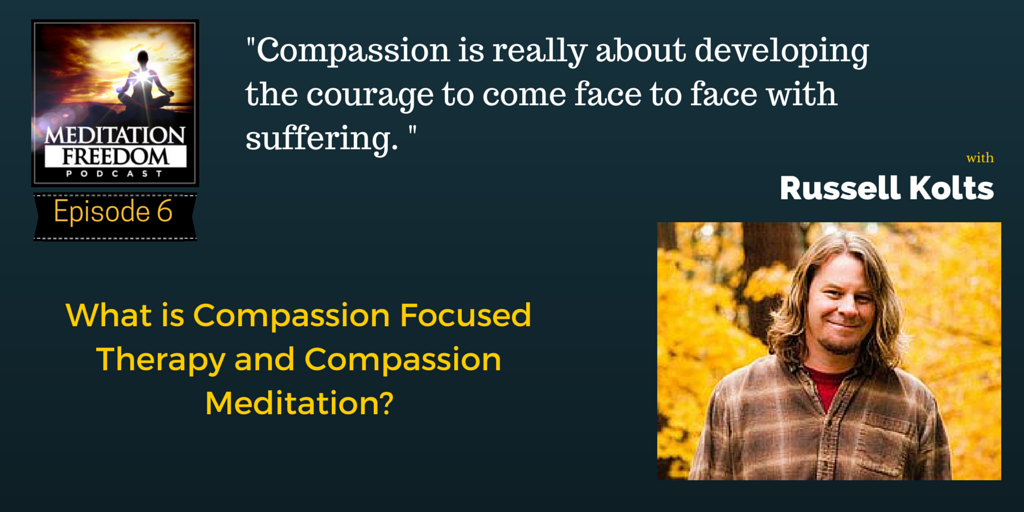
Russell Kolts Compassion Focused Therapy Interview
This is a summary (not a full transcript) of the interview with author and professor Russell Kolts
Russell began with an intense study of Buddhism; reading, meditation, and doing retreats after three years, he realized that a compassionate, mindfulness practice had been life changing.
He says that it was the birth of his child about how he was motivated to start a a meditation mindfulness practice after his son was born. He taught compassionate therapy, and since he struggled with negative emotions in his own life such as anger, and irritability. He observed himself not following his own advice. So he deepened his practice. He realized, “if you want your child to become a good parent, become the person you want your child to be”. What message do your children get from their parents? So he started doing meditation practices, and learning from Buddhist teachers like the Dalai Lama.
He was then later also more able to bring what he learned in his meditation practice and into his psychotherapy work work, by focusing on, “Compassion Focused Therapy”. He then had a scientific scaffolding for working with the mind.
Some examples of practices that would work for him in the moment during.
Mindfulness meditation helps notice what is moving in the mind, such as anger and irritation. This practice helped him recognize it earlier, so just by naming the emotion, it reduces it’s hold on the person.
Meditation and cultivation of compassion have gradually transformed his experience so that the destructive emotions came up less, due to ongoing work with with deep awareness.
Switching out from “that’s a bad emotion” and judgments, looking more deeply, what’s going on here, and other habitual responses.
Working with close family members shows that it is not easy to not be reactive.
Insight is hugely trans-formative
From a scientific perspective, those destructive threat emotions such as anger and fear where designed by evolution, so we can make a rapid response.
The compassion work is by seeing how the threatening person also wants to be happy and maybe our goals conflict at that moment. And at that moment. Shifting from judging and labeling to understanding.
Things don’t always go your way. It takes practice to react with compassion and understanding.
He brings mindfulness and compassion into his classes. He has a course on Compassion Focused Therapy, which involves compassion meditation and mindfulness meditation. Students are meditating in the class, because there is just no other way to learn about it.
He sees how it affects the classroom, students feel safer, they can think better, and more reflectively, and they can have dialogue, since there is a container there. It helps the students with difficult course subjects, helps them to center themselves. They don’t necessarily struggle with the problem, but more with the idea, a self-limiting belief. “There’s something wrong with me” is the most threatening idea, very distracting. Meditation helps you recognize these experiences that come and go in the mind, and not necessarily see them as real or true. Notice them, and let them go.
Slowing down their breathing helps the students. They’re not just techniques on the pillow, but at some point it needs to come off the meditation cushion. At some point it has to come into our lives, and begin to transform. It begins to happen behaviorally, and neurologically.
Other Benefits of meditation practices
Russell thinks that because the world moves so quickly, we’re constantly connected. When he was growing up there were just 4 TV channels, now hundreds, tweeting etc, is all wonderful and convenient. But we’re training our brains and minds to expect a certain high level of stimulation. And we’re not designed to function like this all the time. Just sitting and breathing is hard enough! We’ve trained our brains to expect this level of stimulation. To just sit and do only one thing. If you can’t even sit for 5 minutes, its a sign to learn to slow down and be here now, with full focus of one’s mind. And maybe that’s reading, listening, and be fully present is tremendously powerful. If you want to be really good at something, you can’t be dividing your attention. It’s too stressful to maintain that kind of fragmented attention.
We just need to learn to slow down. He orients students on the front end that this is going to be uncomfortable at first to meditate. Key is to start very small, may start with a minute or two minutes, and go up from there. One of the biggest impediments is expectations. Folks don’t realize that it is actually very difficult. So they get frustrated with themselves, and they give up. In the West particularly we move into this self-criticism.
1. One thing we’re doing is to stabilize our attention
2. Training ourselves to see mental experiences and feelings as mental events, and not necessarily the stuff of reality
3. Training ourselves to notice the movement in the mind. Mentions giving a ticker for a finger biter, which helps train themselves to notice when they start doing the biting. Same with mindfulness. From this perspective the distractions are not a problem at all. These are opportunities to notice movement in the mind.
Russell’s focus right now is Compassion Focused Therapy to help people with emotions like anger. He’s currently working on “CFT made simple”, to help clinicians help their clients. They’re doing more research to demonstrate it’s effectiveness. It really helps that the science is beginning to be there, they now have data to demonstrate it.
He’s starting to see increasing interest in institutions. Lots of misconceptions still about compassion, it’s not being “sweet and nice all the time”.
Being sensitive to suffering and help out in an enduring way. It is still hard to pursue compassionate agendas in politics, because the money is not yet going there. We can have both, compassion and a good bottom line.
If you’re interacting with compassion and mindfulness, you can spread that pro-social stuff.
Russell Kolts one tip for dealing with an oncoming destructive emotion.
When we notice, “I’m getting angry, anxious, etc”. Take 30 seconds to a minute. Slowing down the in-breath (in CFT it is called “soothing rhythm breathing”) and the out-breath. And after that ask yourself the question, “what would be most helpful in this situation”? What would I want them to understand? Slowing down the breaths doesn’t make the problem go away, it just softens, gives “that thread stuff”, gives it some space.
Our breath has a tendency in our lives to go higher and more shallow. It is easy to test this. While you’re doing something, like working, or sitting, or standing in the middle of the day, close your eyes, and simply take 10 breaths consciously. You’ll notice right away that your breath and body relax a little more, the breath then naturally wants to go down to your belly or abdomen, where there is more spaciousness. In other words, it does not feel right breathing from high in your chest. It may take a few times to notice, but you’ll soon discover that you want to breathe more deeply.
2. Body Posture
If you have an office job, it means lots of sitting. If you can occasionally get away with closing your eyes or taking 10 breaths, you can become aware of posture issues. if you were staring at a computer screen or smart phone, notice if your neck or head is extending. This happens often over time, where the longer we sit behind a computer screen, the more we start, “leaning into the screen”. This pause and internal checkup tells you whether your body is still in good posture or not. If your neck tends to extend forward, that will cause bad posture and symptoms like neck, shoulders and arm tensions over the long run. Give yourself a short breathing/meditation break every so often, I prefer every 25-30 minutes. This way your body posture will benefit (assuming you have a posture issue). If you don’t have a posture issue, at least it will let your body relax.
3. Oxygenation of your whole body and brain
Taking conscious breaths, means taking deeper breaths. Taking deeper breaths feels a lot better too. Part of the reason for that is that you are providing extra oxygen to your body and brain. This oxygen exchange where you take in more oxygen, and let go of the carbon dioxide, is always good for the sense of well-being. Try it at least once a day, and also notice how it increases your productivity.
4. Reduce the stress inducing Cortisol and fight or flight response
Stress which most of us get on a daily basis in some for or another, will increase our levels of cortisol, which is associated with the fight or flight response. While this response is sensible in a truly threatening situation, it can become harmful this state becomes permanent. By taking periodic mini-meditations, we can activate the parasympathetic nervous system which in effect allows us to take a breath and a step back. This will in turn, reduce the harmful cortisol levels, and a relaxation response results.
5. Lowering Anxiety, Blood Pressure, and Heart Rates
There is a growing body of research showing that slowing down our breathing through meditation is going to help lower our blood pressure, anxiety levels, and heart rates. Slowing down our breathing regularly, or getting into this habit will long term help prevent stroke and many other health problems. Then of course there are many other benefits, like better concentration, more productivity, better focus, etc. Each of these benefits is a reason in itself to take up this habit of taking meditation time-outs, or mini-meditations throughout your day.
These are just 5 reasons to try mini-meditations today. Please comment if you found another reason to do regular conscious breaths throughout your day!
Walking meditation in a nutshell is consciously paying attention to each step you take in life, learning to be mindful to the matter at hand. So it is in a very literal way of walking, but also in a meaningful way that extends throughout other areas in our lives. As mentioned, learning to be mindful in each step helps not just with the physical act of walking, but ripples out into other areas in our lives. There are different ways to do walking meditation. There are both physical and mental things to pay attention to.
"Oh, beauty before me, beauty behind me, beauty to the right of me, beauty to the left of me, beauty above me, beauty below me, I’m on the pollen path" Navaho Wisdom
Why do Walking Meditation?
1. Too much sitting. Most of us in our daily lives and jobs do a LOT of sitting. Our lives have become very sedentary. I’m no exception. My day job involves primarily working on a computer, and sometimes for long stretches at a time. Then I either sit in a car, and drive home (I try to bicycle whenever I can). Then at home, I do some work around the house and in the garden, and then often get back to the computer, or sit and talk with my wife, and read, etc. On top of all that, if you practice sitting meditation as well, well, that is even more sitting! So walking meditation is a way to stay active, and alert, and become present.
2. Another reason why to learn walking meditation, is to use this practice as another aid in meditation. Which is to say, another way to appreciate our life, the present, and everything we love and have. While it is great to practice meditation or prayer, or listen to meditation music in the mornings, or when we’re home. This leaves a long day in the middle that can quickly fill up with distractions, and business that can fill up our minds. So adding walking meditation throughout the day can really help us maintain presence awareness, where sitting meditation would not be feasible. Walking meditation can do for our minds the same thing sitting meditation can do, it can help us stay alert and present throughout our day.
The risks of too much sitting..
With all the research that has been coming out about the dangers and risks of too much sitting, walking meditation is becoming an important tool in avoiding these risks.
In my particular case, I have a back that is more prone to back issues, due to a sciatic nerve that is easily agitated with too much sitting. As happens with a lot of computer workers, my neck and head are also prone to lean forward (especially in front of a computer screen). Hence, I not only want to get up frequently, but feel an urge (signal from my lower back and maybe a stiff neck) to get up and moving at least once or twice an hour. What I do when I walk around the office building is primarily walking meditation.
How to Practice Walking Meditation
Walking meditation can be done at any pace, however, it may make sense to try slowing down when doing walking meditation. That way you can learn how to do it, you learn to pay closer attention. And as a result are more likely to do well when having to walk fast. One of the reasons for slowing down during your walk, is that it is easy to miss what is going on in our bodies (and around us). Let’s break this down into a few components:
Breathing and posture during walking meditation
During walking meditation, pay close attention with your awareness to your breathing, both your in-breath, and your out-breath. Where are you breathing from? Your belly, or your chest? Just as in sitting meditation, make sure you aim for breathing from your belly. Is your belly relaxed, or tight? What about where you walk, if you are crossing a street, is your breathing more uneasy then walking down a busy street or a quiet street? What about a nature path? These may seem like insignificant differences, but they can be very different. I rarely see anyone crossing a street relaxed. Especially when crossing, many people hurry. I think we are conditioned to feel like we’re holding up traffic if we don’t rush. While this may be great for the car driver, and there are good times to walk defensively in case the driver is not paying attention or texting while driving. It is good to ask why? Why is my walking indicating that someone driving a car is more important? This is just an example, but it give you an idea of the kinds of observations that you can have when you slow down and pay attention to what is happening in your body just with the breath.
Noticing the world around you during walking meditation
Besides being aware of what is going on inside your body to reduce stress and incorrect posture, it is also a great time to become aware of everything around.
Hear the sounds such as your own footsteps, those of other folks, the car tires rolling around next to you, the distant train sounds. Try hearing without labeling or letting them turn into thoughts and mental diversions. In other words, being present for each new sound, instead of getting stuck on one sound, or tuning out after one sound you like/dislike.
Smell the scents, the asphalt, the fresh snow, or the blooming trees and flowers. These scents also bring us back into the present moment.
Feel the wind, or gentle breeze flowing around your ears, or through your hair, through the leaves at the trees above you. If there is no wind, what does the stillness feel like? What does it feel like to walk? Notice as much as possible all the various parts in your body, some may be painful, some may feel pleasant. Meditation is just noticing, acknowledging, and accepting these things, then letting it go. Not dwelling anywhere in particular. If it is something that requires attention, such as a hurt ankle, or something else that requires medical attention, then of course we need to take action.
Touch the earth with your feet of course. But notice the whole movement of your body, so that each step is unique, valued, and acknowledged. It’s the journey in other words, not so much the destination that really matters when doing walking meditation.
See the world around you as it really is. Again here it helps to slow down when you walk, you don’t need to walk in a funny way to fully experience the joy of walking meditation. Just occasionally try walking at a leisurely pace. Perhaps you see the leaves twirling, or you see the sun reflecting off the glass windows on the buildings across the street, or you see the smile on the mother’s face. Or you see the beautiful sidewalks, or the cracks on the wall in the corridor. Just remember, you are seeing in way higher resolution than the latest High Definition TV. Easy to miss the beauty all around us at any moment.
The faster you walk, the harder it is to process and appreciate. But also, the more your mind is in turmoil, the harder it is to process anything you see, hear, taste, smell, or touch. Jesus is attributed to have said in the Gospel of Thomas, “The kingdom of the Father is spread upon the earth and men do not see it.” Walking meditation is one way to start “seeing it”.
(I would love to see what you are finding when you do walking meditation. Please post a comment with your experience below!)