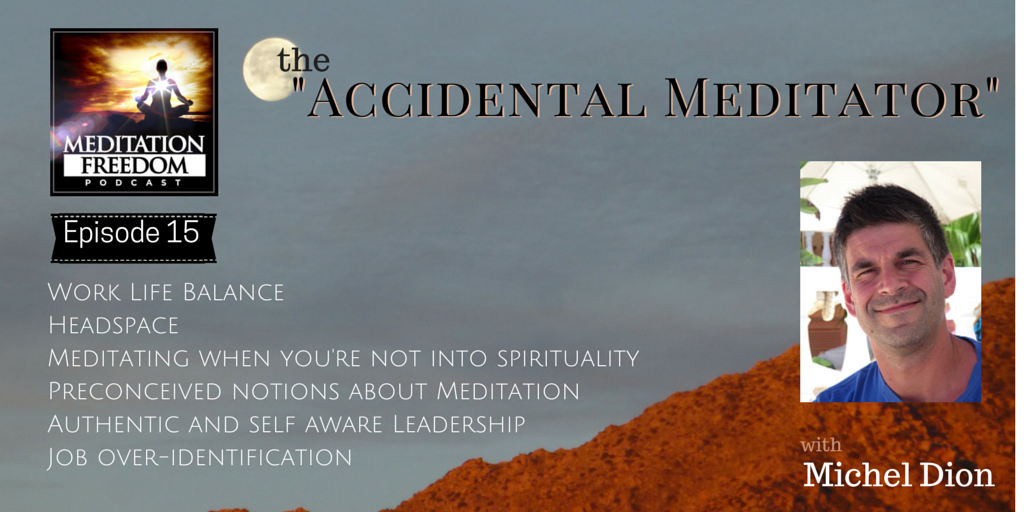
Michel Dion is a CPA and PMP who spent his life in the business world. He has developed a website on project management, called Project-Aria. The name of the website is a mix between his interest for music and project management. He likes to live life fully and passionately. Yet, someone he discovered meditation and the power of the discipline in all dimensions of his life.
Michel also recently published a book called Leadership Toolbox for Project Managers. In the book, he has included the importance of self-awareness and development of the leader as a person as part of leadership skills.
This is a summary (not a full transcript) of the interview
In this podcast we have a conversation about how Michel Dion:
Got started meditating because of too many thoughts and not sleeping much anymore at night.
Michel became an “accidental meditator“.
He is great at solving problems, but it started affecting his family life. He started seeing his friends get burned out by overwork, as well as develop depression. Now in his early 40’s, he couldn’t bounce back from the lack of sleep as much as when he was young.
He was attracted to start meditating after watching a BBC documentary, Michael Mosley’s Horizon: The Truth About Personality (BBC Two) in which Mosley tries mindfulness meditation based on scientific findings about our personalities. And see if he could influence his more pessimistic and insomnia prone personality. He wanted to see if he could change his brain less anxious. They found that the right side of his brain was more active than the left side, which also created an imbalance. A combination of cognitive training and mindfulness training was used to help him change his brain. See, “Can Science Explain Why I’m a Pessimist?“
Michel was inspired by these findings, and also wanted to learn this meditation, so he got the Headspace app by Andy Puddicombe, a former Buddhist monk.
He needed to start with guided meditation. Very useful, otherwise he would have felt lost. He doesn’t consider himself spiritual.
He also noticed more and more projects as he grew in his career, and he was never in the moment any longer. He’d be at work, as well as with his wife, and always thinking either about work or other things. He couldn’t be present any longer. Starting to lose focus.
As a result of a regular meditation practice:
He found that the meditation helped him be more productive at work.
Better and more real connection with his wife and kids.
He found this important enough, that he mentioned meditation, requirement for self-awareness as a leader in the beginning of his book on Business, Project Management, and Leadership, rather than an afterthought. Taking care of yourself.
At the time of this interview..
He still practices regularly using head-space, listens to podcasts (this one, and Tara Brach’s Podcast), and reads about meditation.
Michel is learning how to meditate without the assistance of guided meditation, or apps. He plans on adding unguided meditation to his practice.
Michel had to unlearn some preconceived notions and pressures about what meditation is supposed to be like. Typical misconceptions propagated:
“You can stop all thoughts!”
“Real meditators are always 100% peaceful and happy!” (as though they are no longer human!)
“Multi-Tasking”
Michel was a great “multi-tasker” at one time, but learned that this wasn’t working very well.
He would do other tasks while “listening” to his wife. After realizing this error, he now has a deeper connection and conversation.
Another challenge he has is with long-distance running. At some point his mind is, “no longer in the moment”. It’s not physical pain that’s the problem after 2 hours of running, but his mind. He is going to read the book by “conscious runner” Lisa Hamilton (former guest on this podcast).
How his meditation affects his work, and leadership role?
Very much, as a leader you can be agitated, “do, do, do, more, more!” But people are more likely to follow a leader that is calm. Then a leader that is helps give their team confidence of success. Comfort zone does not mean it’s easy. You get greater results with a team with greater self-awareness.
Authenticity and honesty are often lacking in leadership.
In business you can master something. Michel studied classical music when he was younger and you can master that as well. He feels it’s different with meditation, you can’t say you have 100% self awareness. You can do this for 30 years and you will still discover something, so it’s never completed. There is a level of being comfortable in the unknown.
Michel talks about developing more knowledge of the self, which is part of executive leadership development program. Meditation and modern science is bringing it to the western world from a different angle.
We discuss how meditation is sexy or trendy, and the potential issue if the leadership and executives don’t practice meditation themselves, and use it to squeeze more productivity out of employees, or put them into smaller cubicles to save money, without thinking of the triple bottom line.
Michel talks about the blind spot of leadership, the privilege and rank of leadership, and the problem if you just have false relationships around you. It’s his job to create a relationship where the employees feel comfortable talking with him.
Why it’s a problem to be over identified with your job (and Michel sees this more in older generations).
It’s better to have a life also outside of work.
Why it’s not always the best if someone is 100 % dedicated to their work life, doing 60-80 hours a week. You don’t have as much motivation to be efficient, if you’re just making work for yourself, “looking busy”.
The mind needs some break
If you invest all your thoughts into one thing, the day it succeeds, you’re extremely happy, if it does not succeed, everything is crashing.
The intensity of reactions at work, are like for a nuclear plant, small problems are turned into big dramas. It’s not like your two kids are dead!
It’s rare that someone will crash their career over an intellectual issue, it’s more the emotional side of life.
If you want to maximize you need to have an authentic holistic view of human.
We talk about too much drama when there is an issue at work, taking our titles and roles too seriously.
Michel talks about an example of a stressed out employee who was thinking she needed to spend the night fixing things, and he just told her to go home and watch a movie, and sleep on it. Sure enough, the next day, the employee came in refreshed and was able to solve the problem easily.
When do you have your sitting meditation during the day?
He seems to meditate best when his mind is tired.
He also likes long distance hiking, he likes how nature calms him. We talk a little bit about nature-deficit disorder.
He puts his device on airplane mode to keep from getting distracted. When it’s on, the mind stops checking. He finds that better than a technology fast or rejection.
His book is for folks leadership, the most powerful powerful part of leadership is to lead yourself first, before leading others.
Never have only your career as defining who you are.
Michel would feel more lonely without technology, to find other like-minded persons. That is an example of where technology supports personal growth.
Michel Dion is a CPA and PMP who spent his life in the business world. He has developed a website on project management, called Project-Aria. The name of the website is a mix between his interest for music and project management. He …
Interview with Kenley Neufeld of the Deer Park Buddhist Mindfulness Community. Kenley was ordained in 2005 by Thich Nhat Hanh as a lay-practitioner in the Order of Interbeing with the dharma name, True Recollection of Joy. Kenley received the Lamp of Wisdom, permission to teach, from Thich Nhat Hanh in 2012.
This is a summary (not a full transcript) of the interview
What brought you to a meditation practice?
How did you get started with meditation?
Kenley took a world religion class in the late 80’s. Then in the 90’s he’d been participating in 12-step recovery process in San Francisco where he lived at the time. The program had a meditation portion. He then went to a Zen Center, and didn’t get into it. But after picking up a book, and sitting by himself worked better initially.
So it blossomed out of the 12 step recovery experience. He wanted to try meditation to get in touch with the spiritual side of his life.
Is the meditation offered as part of the 12-step?
Yes, some it’s part of the spiritual practice and some of the groups do it. To deepen our spiritual practice, and being able to sit still and be able to reflect on this thing called life, and the directions we want to go.
He just wanted to do a little more than was offered. It was an easy segway to explore for himself. He”s always been on a spiritual journey for most of his life.
Where there any particular struggles at the time?
It was more of a general spiritual search. He was taking his recovery very seriously at the time. And one of the steps is to explore meditation. So he was trying to explore meditation. Coupled with his experience with the world religion. His wife also gave him a book, “Peace is every Step” which also influenced Kenley.
As you practiced over the years, did you see other good reasons to practice, like finding it helpful to pay attention for example? Was there an aha moment?
It didn’t really come until years later. 1995-2001 he did meditation regularly, he like the way it helped him to stop and become aware of his body. It was still very rooted in the recovery program, it was part of the puzzle of being clean and sober.
But something happened that pushed him unto the high speed conveyor belt, moving forward on a path of mindfulness and meditation and transformed his being in a much more significant way, then all those years he did it on his own.
Yeah there is a big difference, between doing it on your own and with a community or group?
Yes, what happened is September 11, 2001 (the terrorist attacks for those unfamiliar). Kenley was quite traumatized on different levels. Some experienced the horror of the towers coming down, but also our response to that. That is what pushed him to see clearly how important community was.
He was drawn to, and needed to draw himself in to others who felt like they could bring peace, and be peace in the world. And he couldn’t do this by himself, or through the recovery program.
He needed to find a spiritual community that embodied that concept of being peace in this world.
So he went to the Deer Park Buddhist monastery in Escondido, California, and learned about being in community with people. And he went home to Fresno, CA where he was living, and started a Sangha (community).
And that completely changed everything for him, just sitting and being in a community and practicing with people. Allowed him to walk through this very dark time in American history. We struggled as a nation.
Being in a Sangha helped him to navigate that, and not let anger be the primary feeling in his life. He felt meditation could transform that anger from 9/11.
When you saw the reaction of a lot of Americans and the world. You wanted to respond in a different way than with anger..
Yes, absolutely. The timing was amazing, because Thich Nhat Hanh had just published a book around 2001, called Anger: Wisdom for Cooling the Flames
And he was on tour at that time. And he was reading it, and he realized he had to do something different in his life, put more effort into what Thay (Thich Nhat Hanh’s nickname) is talking about.
He is a teacher who speaks extensively about Sangha. Community is so important to our well-being and society. How important the 3 jewels are, buddha, dharma (teachings) and sangha (community). Thay’s teachings on peace, social work, social justice work. That really attracted me to his community in particular, that’s where I decided to put my energy and time.
You also mentioned (as part of your commencement address), that a lone person shot up the UC Santa Barbara campus across town? How does loneliness contribute to the anger?
He was a student of this Campus as well. This goes back to the idea of community. The human being really craves to be together with others.
In this last century we’ve become disconnected from the roots of our families and communities. It’s so easy to move around, travel and live a thousand miles away from them. That was not the case earlier times. Not to say there is no suffering in those environments. All those elements build the support network that allows for us to see each other.
Not being seen builds this loneliness, coupled with mental illness can lead to those tragic events.
I do believe, we can work together as communities to bring a little bit more well-being into society. It starts with our own selves, with our own practice. How we’re able to transform our own suffering, our own loneliness, and being able to see with a different set of eyes.
Thay talks about looking deeply, to see you’re not a separate self.
Yes, the inter-being nature of all that exists. Essentially, we all come down to being star dust, all the way to the present. We have this relationship with this planet, there is no way to separate each other. Without the sun for example, a big thing that is clear, without the sun there would be no life. But that can all come down to our most intimate relationships. And how we connect with each other, the connection between the past and the present. Which can then inform the future.
Explain Inter-being a bit more for someone new to this?
For me that means there is this idea that there isn’t any separate self. I am because you are. Because there is this connection between us. Our relationship exists, my well being and my taking care of the plants, will bring well-being for more than just me. For everyone else as well. For example, on a physical level, the air in my house is exchanged between my family, my self, pets, plants, etc.
There is no separate self, this is one of the most deepest teachings of the Buddha. Thay says, we can’t have the lotus without the mud. There is this relationship with the lotus and the mud. That is that inter-being nature of all things.
What types of things do you still struggle with today?
I always need to come back to, and remind myself that meditation is not just what I do on the cushion in the morning when I get up. I spend my 45 minutes or so in meditation to bring awareness to my breathing, and look deeply at something in my life.
But what i try to remind myself is that that meditation is what I try to do each moment of the day, and how I wake up in the morning, how I walk across the floor, how I brush my teeth, How I prepare my meal, how I drive my car, how I interact with the people at work.
It’s not a struggle, more of trying to always remind myself that each moment is a moment to be mindful. And to be present for what is in front of me.
Just like we’re speaking right now. When misc thoughts arrive, like “why did I say that”, that could be going on in my mind when I talk with you.
Meditation is being aware that this is happening.
Recognizing that it’s happening, and
Letting it go…(without judgement)
If I can do that in all aspects of my life, then I walk more in a free way, can be more at ease with my interactions, and those things that go on around me. That’s what I try do with my meditation these days with varying degrees of success..
What advice would you have for folks who do struggle with those types of things, bringing their meditation, their presence, being fully present into their daily life?
The best thing we can do to support our practice, is to create an environment in which we can practice. I try to set up conditions and reminders, so that I can have that opportunity to practice. Whether a little sign by the sink that has a little Gatha, that reminds/tells him what to do when brushing my teach. So I set up a condition to allow that to happen in the bathroom.
I’ve trained my mind to have a little verse. When I wake up , i have a little verse, it took months, perhaps a couple years to automatically remember this when I wake up.
“Waking up this morning, I smile. Twenty-four brand new hours are before me. I vow to live fully in each moment and to look at all beings with eyes of compassion and love.”
So that when I wake up, it just comes, it arrives. It takes some training, so start with a note. This also comes in my work environment. I want to be present for the people at work. I put the computer out of the way, so I have to really talk with them, not have that screen distraction. I keep my desk clear as well. Again setting up a condition, so that there is nothing there to distract me from being there for this other person. This is there for me, to remind me.
That is how I practice my mindfulness in each moment.
Do you also take out time-outs during the day to take a few breaths, (mini-meditations)?
Yes, he uses a computer program to call for him to stop occasionally and take a breath.
Walking Meditation at work
He also practices walking meditation when he moves between buildings on his campus. All it needs to do is bring attention to your breathing, and your footsteps, and avoid the texting, phones, etc, distractions. Keep that in his pocket, and enjoy the beauty of the environment where he works in. Avoid multi-tasking. It all takes discipline, a lot of years.
There are so many opportunities for practice.
The sitting practice informs the rest of the day, so that part is important. Looking deeply into my being, it would be more challenging if I did not do that. It would be harder to bring that awareness into other parts of my life without the sitting practice at the beginning of the day.
There is no such thing as multi-tasking. See research debunking the virtues of multi-tasking. It is really switching activities quickly, is not good for cognitive process. It could have long term impacts. Kenley has made changes in his physical environment to support LESS multi-tasking. Like turning off all notifications on his phone. It’s no good for it to be beeping at him every 20 seconds. He doesn’t need those constant distractions.
Thay is a good example, takes his time drinking his tea, and yet super productive, he’s written like 90-100 books now?
Yes, I look at someone like my teacher, with seemingly endless energy, almost 90 years old. So there is a way to do it, and be peaceful and free.
Having the mindfulness practice helps to ground myself, and know when to be productive, and also when to rest and take care of myself. To take it easy and not push myself. He’s definitely an inspiration. He’s currently recovering from a stroke.
What do you think Thay means, when he says, “The Buddha is the Sangha”?
He talks about the collective awakening we need, the power of the community. Like M Luther King, about the beloved community. We have this ability if we work together, to transform ourselves, our communities, and the world. We don’t need to go into dispair. There is this capacity to go beyond that. The “Buddha community”, being our capacity to live in harmony and transform our society and our world.
Also a not just one person responsible, co-responsible to awaken.
We all have this capacity to wake up, individually. Each one of us, we can do this together also.
Do you see this at your work, any movement towards mindfulness into the institutional culture, to the physical campus?
Yes, the wake up community 18-35 year folks. They will go out and offer programs, and lead meditations with college campuses. Kenley also does a meditation group on his campus, not affiliated with religious organization. Not yet a dedicated space yet. He’s always done it in his office so far.
It’s starting to happen more in the corporate world, with providing opportunities and spaces for employees.
Practice Centers also in Deer park Monastery (also in Germany, NY, Hong Kong, Australia, Thailand, and France)
Wake Up for young people (Wake Up is an active global community of young
mindfulness practitioners, aged 18-35, inspired by the teachings of Zen Master and peace activist Thich Nhat Hanh. They come together to practice mindfulness in order to take care of themselves, nourish happiness and contribute to building a healthier and a more compassionate society.)
This bell is a lovely sound to help harmonize our breathing and our body.
It’s an opportunity to come back to our true selves, to come back fully to this present moment in time.
To be able to let go of our worries, our projects, to come back fully to this present moment in time.
To be able to give all our attention to the sound of the bell.
Breathing in, I hear this sound of the bell.
When I invite the bell I have a verse (invite is a gentler term chosen then striking a bell)
Sending my heart along with the sound of this bell, may the hearer awaken from forgetfulness, and transcend all anxiety and sorrow.
You as the listener can come back to your breath, and be present, and listen, listen to this wonderful sound of this bell. Calling you back to your true home.
The following video was discussed in this interview, as a mindfulness tool for during an 8 hour work day. The bells will go off every 30 minutes, allowing you to take a few breaths, and a time-out, increasing your energy and productivity.
Interview with Kenley Neufeld of the Deer Park Buddhist Mindfulness Community. Kenley was ordained in 2005 by Thich Nhat Hanh as a lay-practitioner in the Order of Interbeing with the dharma name, True Recollection of Joy. Kenley received the Lamp of W…
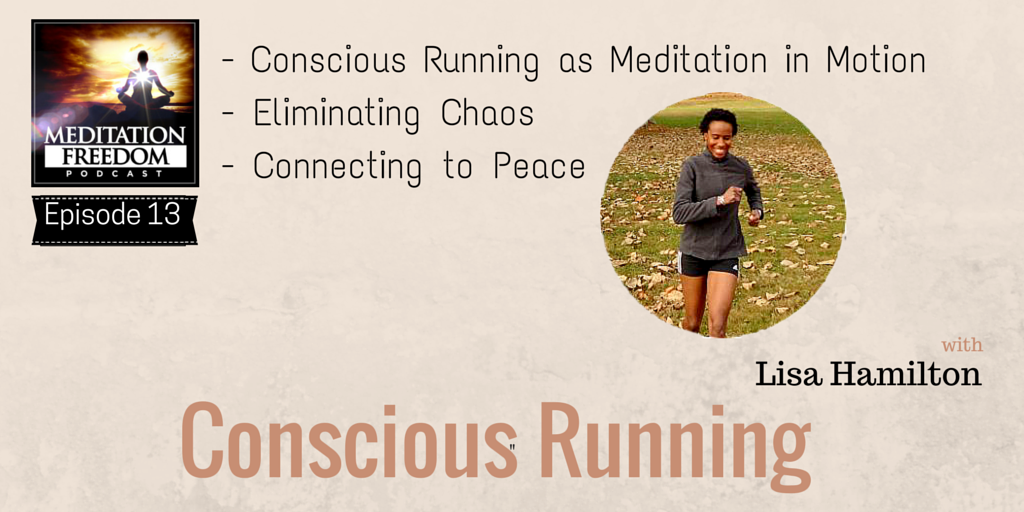
Interview with Lisa Hamilton of the “Conscious Runner”.
“Running is my form of meditation, my meditation practice.” Lisa Hamilton
What brought you to a meditation practice?
Trying to eliminate chaos in her life, and also in her mind, and connect to peace in a nutshell.
You mention a natural disaster, hurricane Hugo in your book, what is the role of that major (traumatic) event in your life?
Lisa says that it did transform her, and she was traumatized by that experience. She still finds herself shivering and having other symptoms when there is a storm. it can leave remnants. It still to this day has somewhat of an effect. She doesn’t necessarily think it changed the way she views things. She’s always known that there’s more to life than money, cars, etc. Just a knowing that there was more to life..
She wasn’t brought up that way, it was a painful upbringing. In part to escape that pain, she had to believe that there was something more to life.
What problem where you perhaps trying to solve with your meditation?
She didn’t approach it as a specific problem, like working on forgiveness, progress, or self-esteem. I wanted to solve the problem of chaos and unhappiness. Once I could connect to source into the present moment, that all of those other things would disappear. Going for the root than dealing with the limbs and for the branches.
I don’t look too much for the branches. She always knew that there was something even larger than that. That if she just addressed the root cause (her chaos and unhappiness), then the rest would just fall away by itself.
You mentioned you had to love yourself, imperfections and all. Did that chaos disconnect you from being connected.
Yes, some of that came from the Oprah show. She love Oprah like a mother. Back in the 90’s, Gary Zuchov was one of her favorite spiritual teachers. The world wasn’t ready for that at the time, she was crucified for it. But Lisa knew there was value for her in those interviews. She resonated with those interview. She played those over and over again, and learn more and more from it.
She said Gary was lighting the path for her, she decided to stick with it. Because this was the way she was going to “get it”. After this things became more clear to Lisa, that she had to love herself, imperfections and all. She is a great soul, that every place is a holy place, not just in the confines of a church. It can be anywhere.
Did those teachings turn you towards a meditation practice?
She turned towards running as a meditation practice, not sitting meditation. She could not resonate with that practice. She learned that meditation is anything that you can use that brings you into the present moment. Meditation is just a tool or a technique. There are many meditators sitting in cross legged positions who are not really meditating. They just look like they are.
So running is my form of meditation, my meditation practice.
Did you just discovered it?
Yes, she discovered it, she just knew it. That was her form of being able to connect with source, and the present moment. And to experience her mind and body the way that she wanted to. Her running is more directed inwardly from the kind of feeling that she wants to have, and those are the tools to help her get that.
So you didn’t have a teacher or way to know how to know to get out of your own way?
Yes, any time your minds are in the way, it prevents us from getting into the now, the present moment. Whether we’re focused on the past or the future. She did go to a class in meditation and she found that sitting meditation did not work for her. Sitting meditation does work for her in a sauna, because of the heat. Which helps her with her thoughts.
Tell me more about how the thoughts when running, prevent you from getting into the zone, or peak performance.
Yes, anytime we have thoughts, thoughts carry energy. Negative thoughts are heavy, and positive thoughts uplift us. If you carry a log of negative thoughts, they can actually make you stop (literally) where your body stops. Next thing you know, your legs feel like legs.
But changing all of that is literally only a thought away. Focus on what’s right and positive, and you can be restored.
Explains her experience with wind and trying to run, and she could barely move her legs. So she started to think she couldn’t do it., but then she stopped, and got her mind right. Then when she got back on her run on the trail, and it ended up being her fastest repetition out of the six, and it was into the wind. And all she changed was her mindset!
It’s the difference whether she goes out for a run or not, it all begins with the mind.
Expand how your beliefs are another layer that affect your thoughts?
Yes, there are different layers, thoughts are like particles in the air. We can’t always control what comes into our heads, but we can control what stays there. Part of what does stay there, is what resonates with the believes that we have underneath it. So you have all these thoughts that are floating around, and we pick the ones that resonate with the beliefs that we already have. And letting those go that we don’t.
If you have positive self-beliefs, then the chance are you’re going to pick the positive thoughts in this massive thought cloud. Whereas with negative believes, you pick the negative ones.
With pulling out something at the root. If you don’t just go after the thoughts, but go after the underlying believes, then all the other thoughts, you don’t have to fight with the problematic thoughts. Once you think your’e worthy, lovable, you don’t have to work at confidence, self esteem, and peripheral things.
What would you say with those who struggle with the self-limiting beliefs?
Replace and address and replace the beliefs with more positive ones, and do the inner work to change the beliefs to more positive ones. Stay in the present moment, which allows those beliefs to transform. Staying in the present moment helps, there is no past and no future, there just is. And our beliefs come from the past.
How do you define success with athletes?
A lot of time we think success should look a certain way, influenced by our parents, teacher, etc which dictate how we define success. Success is defined by how content you are, how much at peace you are, or how whole you are. And not necessarily by what time you got on your run, those too of course are successes. But let’s not miss all the other successes in addition to those.
Yes, the sport won’t always be there. It will transform. You do find that with athletes, they lose themselves in sport, and when the sport is taken away, they don’t know who they are anymore. Any time we’re identified with a role. It isn’t just with athletes. You see it with other professions, so identified with their job, or mothers with children who leave, etc. Anything you become identified with.
At some point you became connected to something much larger than the limits of your skin?
Yeah on some level she has always known. When things become hard, than that is the place she goes to, that I’m more than this body, more than this personality.
So there’s also a physical experience?
Yes, I know it. This is what I know for sure, my experience has been.
This changes your stories and way you view the world too?
Yes, it does. I’m here with a personality and stuff that i need to work through. I’ve been fortunate enough to have been in that space multiple times. and it does change everything. You don’t take things so personally. There is more love, compassion, passion, no fear of death. This is what if feels like, when I’m in that space, fully conscious, fully awake, and fully in the present moment.
I too am a work in progress. There are things that happen that take me out of that. When I’m out of that I do take things personally. Then my life does become stressful and chaotic.
What do you do in those cases?
Then I have to make a decision, “so what are you going to do with it Lisa”? Are you going to wallow in the craziness, or meditate, or do some gratitude journaling to get you back there. What role am I going to be in?
So very conscious decision making?
Yes, very conscious, because I’m experience both. So for me it is which wolf am I going to feed? The one of happiness, joy and contentment and peace? Or the one of greed, and anger, and frustration?
Sometimes I don’t feed the right one..
And then you reap it right as I’m sitting there trying to decide, because it is no fun, it’s suffering!
How do you look at flow?
Lisa looks at it as being in the zone, or being present or connected with source, different ways of saying the same thing. Like saying God or the universe.
Is that the same as being in the super conscious mind, and the other two states of conscious you mention in your book?
Yes, the superconscious mind is like being in flow, being in the zone, being fully present.
Whereas conscious mind, you can still be conscious, but still not be fully present, you don’t necessarily notice everything around you, so many thoughts still floating around etc.
You call that the inner dweller, the 80 thousand thoughts that are clouding one’s mind, like a veil between you and reality.
Yes, the difference between living in black and white world, and living in color. It’s amazing when you’re in the present moment. How the wold comes alive, how much connection there is, love compassion, awe, magic and beauty. You stop looking at just people, and you can see through them, you can see the souls of who they are. And relate to that, it’s really amazing.
Do you have suggestions for those who seek a particular state of flow, and then when they can’t run, they may not get that state?
Yes, that is part two of her book, where she talks about the practices where you get into the meditative technique in order to run. It goes through deep breaths, scanning the body, visualizations, transitioning the body, mindset things like setting your intention.
The way to make it lasting is by doing the first part of the book, make it part of your life. So that by the time of your run, you’re already in that state. The only true way to truly be in that state is to experience it. You don’t want your book, you don’t want to rely on it for ever. You have to experience it. Everything in the book are pointers, ultimately you have to experience it.
The book takes you so far, to the gate, the rest is up to you.
If you then still struggle, you have to go back and and find out what is going on.
Lisa can only speak from personal experience. Chaos and drama are not comfortable, we say we want peace, and presence, and joy. In a weird way sometimes we don’t chose the right thing. Because the familiar is actually comfortable, even when it’s not good.
Sometimes the familiar is better than the unknown, even though the familiar is not good. Why people don’t change, she mentions in her second half of the book.
Why do we sabotage ourselves? Sometimes I make a conscious choice not to have peace, why do I do that. Because feeling like crap feels familiar. And there is some comfort in the familiar even though it does not feel good.
You can create a new familiar with being in presence. Why am I afraid? Maybe if I leave the familiar, I lose my friends, or it ties me to my family, my upbringing. If I leave the comfort zone, the familiarity. There’s a lot of layers to this as to why people don’t change.
Yes, maybe small steps for some?
Yes, there are different ways to progress through their lives. Some folks have one really bad night, and that’s the end of the ego attachment, one devastating breakup, their lives just completely crumbling down.