MF 13 – Lisa Hamilton Conscious Runner Meditation in Motion Interview

Interview with Lisa Hamilton of the “Conscious Runner”.
“Running is my form of meditation, my meditation practice.” Lisa Hamilton
What brought you to a meditation practice?
Trying to eliminate chaos in her life, and also in her mind, and connect to…

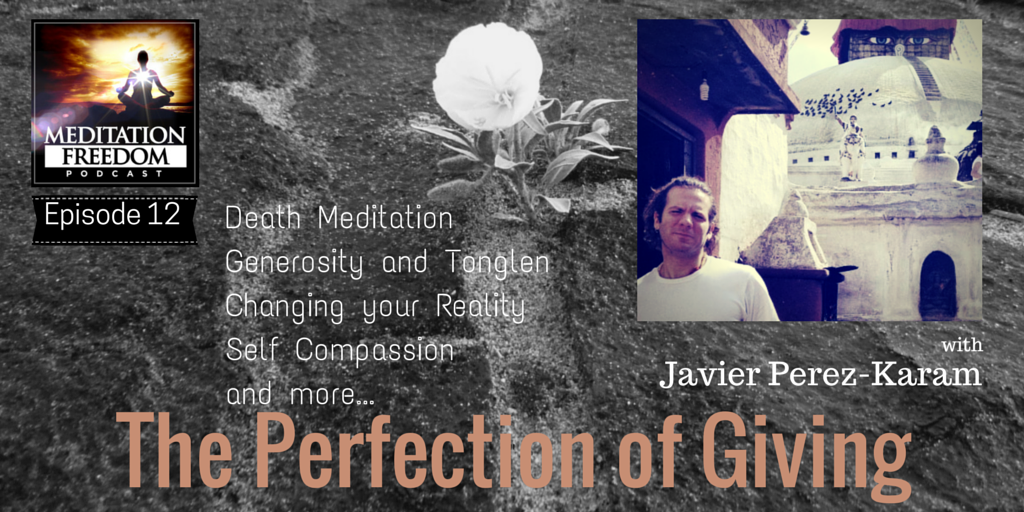
MF 12 – Film Maker and Meditation Instructor Javier Perez-Karam

MF 12 – Film Maker and Meditation Instructor Javier Perez-Karam

Interview with Javier Perez-Karam

Javier Perez-Karam grew up in Venezuela, and relocated to New York in 2002 to pursue a film-making career. In the process he discovered Meditation and Tibetan Buddhist Philosophy, and as he started incorporating the practice into his life, he has gained a new purpose with his film career as well as his recent found drive to teach and share his experience with Meditation within the framework of Buddhist Philosophy and it’s applications to the modern life.

This is a summary (not a full transcript) of the interview

 What brought you to a meditation practice?

His relationship started “non-spectacular”, he was “chasing a lady!” That’s how it started. He liked this woman, and she invited him to a Buddhist meditation class. He couldn’t say no, so he went. It was Geshe Michael Roach, from the Tibetan Gelugpa tradition. He’s a very polarizing person. He became his first teacher, put the seeds of meditation into his brain. Learning about karma, mindfulness. and emptiness. He had already grasped these concepts before from his own experience, but didn’t have a framework for understanding.

Meditation can lead them to the best version of yourself. He liked the promises of what meditation leads up to. His parents were going through a divorce, and he had broken up with his girlfriend, so that further encouraged him. His fiancee calls him an “experience junkie”, so he gave it a try about 8 years ago. It took some time to make it part of his daily life. But it radically changed his way of seeing his reality. But also has a new view of Buddhism.

How did meditation help you with sad events? 

It helped him accept sadness, it’s ok what is going on right now. So it is not so strong of an emotion later. He can now accept it. Through the practice of meditation and off the cushion through mindfulness and in living. He could now better identify what he was feeling and how it made him react to the world.

When his parents divorced, it hurt him very much. He felt physical pain in his chest, he’d never felt physical pain from sadness before. He could better understand it, and now allow that pain to become part of everything else. He did notice how this pain from broken relationships in his family affected how he started seeing others. He noticed he was objectifying women and rejecting love, but it was coming so much from his own relationships, but from seeing the broken relationships in his life like his parents. And by objectifying, he was protecting himself through this objectification.

Through meditation he was able to realize how he was putting on that barrier, and he was able to break it down. After that he started seeing clinging to possessions, and other afflictions in himself. So he could now find the problems in his life, and observe, and re-frame, and then it was not a problem anymore, but an opportunity.

Were there any particular practices that you found particularly helpful with particular struggles?

He read this book by Lama Christie (see link below), about a death meditation. About through visualizations, you try to simulate what it means what it is like to die and see how your possession and loved ones are left behind. It plays with the idea of uncertainty in the time of death. That was a wake up thing. He always liked to think death was far away, so you don’t pay attention. We like to think it won’t happen to us, we don’t pay much attention to our own death.

He started doing this death meditation over and over again. And he could now start to appreciate the shortness of human life, and appreciate the moment, so precious. And the fact that he was experiencing was mind-blowing. It is his choice whether to love or objectify a woman, cheat or not, etc. It’s all based on the choices you make now. That sitting down and self-analysis about mortality, really triggered a deeper practice.  He needed to understand now more of our own reality, and how his mind creates his own reality, through that death meditation.

Was there more of a sense of what the consequences are of your actions?

Yeah, as small and insignificant as our actions are, there are consequences. He can recall things he did when he was a teenager, and now sees how those things created consequences. Very interesting once you learn about karma or the things you put into the world, the causes and effects.

And it then makes you more conscious about what direction you. want to take with your life right?

Yes, completely, that is also where mindfulness comes in. Because you may get cut off in traffic, or you have a fight with someone with work. That is where the practice takes shape in real life, not so much in sitting down. If you’re not mindful in your daily life, you’re bound to make mistakes, terrible mistakes even.

We tend to do something, there’s this urge, and then ohh, shouldn’t have done. The moment you have an impulse, this urge, not surrender to it right away. You take a second with mindfulness, you have that moment to think about it before you do it.

Regret is delayed illumination…

Yeah, we go through life without realizing. Sometimes we think we can get away with it. But when we know we didn’t. We’re constantly judging ourselves.

Do you have more self compassion through practice?

At first more for others, then more recently for myself. He took longer to develop compassion for himself. For such an individualistic society, in the west, we don’t really teach to love ourselves. Sure indulgence our selves, yes, but respect and love ourselves, not so much.

There is judgement in this culture about failing too. We are not allowed to fail in this culture as much.

Initially there’s more of self serving in a way initially because of cause and effect where you make sure it doesn’t come back at you. But regardless that still makes the world a better place.

Lately he has been doing Tonglen (Tibetan) practice, “giving and taking” with his future self.

Has your sense of who you think you are changed?

Yes, completely. When he was younger, he thought his identity was a film maker, and had to get a message out, self serving though.  He didn’t care initially what he was making if it mattered to others. But now after practicing Buddhism, it does not define him anymore.

But with the Buddhist practice, and getting more wisdom, but now his film making career doesn’t define him so much anymore. Film making is now something he does, that doesn’t mean he is that. Now he feels more like a human being, a future father, future husband. He’s in a different framework.

Now the stories he tells through video, he wants to inspire with them, more oriented to what people the world needs. Inspire people to be the best version of themselves.

So what is the film you’re working on right now?

Yes, it’s called, The Perfection of Giving”, a documentary film shot between Kathmandu and NYC. See link below for more info. 108 lives project, from his teacher. The idea was to replicate the project in many other places. Javier wanted to offer his help. Initially just 5 minute pieces to document this giving to the 108 resource poor people, But as he was helping the organization to become bigger. As he started helping, their attitude started changing.

Just a couple hours a day thinking about the needs of those 108 other people. Was making them happy, brutally happy. Ah, there is something here, maybe altruism is not so much about helping others, but helping ourselves, to find ourselves. Not so much about building schools, but helping ourselves. They help people paint schools, teach kids English, etc. And then all the volunteers go back to their own lives. Sure there is an exchange, their lives don’t change much, but the volunteers experience as human beings completely changed! So that is what the story is about.

It’s a very personal film. It doesn’t come from his personal view, but that is not what he hopes it comes across as. Let’s see how it plays out. He’ll put it online after screening it at festivals. And he hopes it will help some people do some crazy non-self interesting things.

You mention non-self, what are you talking about for those who don’t know?

Yes, the blurry line between me and you. It’s the illusion from our own duality of mind. When you put yourself in a very generous position, “playing the Bodhisattva”, those boundaries just blur. When you see somebody laugh, you cannot help but laugh, or if you see someone in pain, you feel their pain.

Is that why you called it, “The Perfection of Giving”?

Yes, it’s exactly about that. In Tibetan Buddhism, the first perfection is about giving, dana. Blurring that space between our body and minds and access to the oneness. Certainly the experience we lived in the movie, was at least a little taste of what that means, that oneness, that blurring between giving and receiving.

So the self and other dissolves in that giving?

Giving is a full circle. There’s someone on the other end of the giving. For that person to be taking, it immediately becomes an interdependent arising. There can not be giving without receiving, not a giver without a receiver. Two sides of the same coin.

When is the film ready?

It’s done already for private screenings. It will be out to the public, depends on how the festival goes. It will be available in September 2015 for watching online (see below for links).

So you are a teacher of meditation?

He guides meditation offerings at the 3 Jewels Meditation Center. He’s now a junior teacher there. He’s also studying under a Shambala tradition. Mostly teaches mindfulness meditation and giving and taking meditation (Tonglen). Easy meditations for beginning meditators. One is based on breath, and the other on visualizations. He does a little bit of both.

Currently also doing an immersive meditation teacher training for a year, at a place called the interdependent project in New York City. They explore together with other teachers, and several lineages, to built more skills together with other teacher. Under several lineages of the Buddhist tradition.

Is there any meditation for really busy lives with distracted people like in New York?

If you are just starting out, recommend anybody to just breath, focus on your breath. Don’t beat yourself up. Your mind is going to wander somewhere else, just bring it back to your breath. Even if you do it “badly”, you can do it, to gain benefits from meditation. It’s better to learn how to breath first.


Resources

MF 12 – Javier Perez-Karam Film Maker and Meditation Instructor

Interview with Javier Perez-Karam
Javier Perez-Karam grew up in Venezuela, and relocated to New York in 2002 to pursue a film-making career. In the process he discovered Meditation and Tibetan Buddhist Philosophy, and as he started incorporating the p…

MF 011 Eric Zimmer of The One You Feed Podcast Interview

Interview with “The One You Feed” Podcast host Eric Zimmer
Eric Zimmer is host and founder of the, “One You Feed” podcast, “. He has also worked with start-ups, doing Management and Software Development, is CEO, Tipping Point Renewable Energy, and all…

MF 11 – Which Wolf is the One You Feed? With Eric Zimmer of the oneyoufeed Podcast

MF 11 – Which Wolf is the One You Feed? With Eric Zimmer of the oneyoufeed Podcast

Interview with “The One You Feed” Podcast host Eric Zimmer

Eric Zimmer is host and founder of the, “One You Feed” podcast, which he and Chris Forbes work on together. On the podcast, he talks about which wolf we chose to feed. Eric has also worked with start-ups, doing Management and Software Development, is CEO, Tipping Point Renewable Energy, and all around an Experienced entrepreneur. He’s also a Songwriter. You can tell tell he is a very curious person by listening to his podcast. This is a summary (not a full transcript) of the interview Eric got introduced in high school by a teacher, he was probably the only reason that he got through high school. The teacher introduced him with Zen books. Eric then got involved with Trancendental Meditation. He took a class in TM. Eric had to bring 3 handkerchiefs as a prerequisite to TM meditation. He then shoplifted these handkerchiefs, and got caught.  He practiced for a short period of time, and then stopped. Over the next 5-6 years, he’d think about it, but also struggled with an alcohol addiction, “a wasteland” as he calls it. He’d have periods where he’d sit and start and stop his meditation practice, and occasionally read books by Jack Kornfield. What drew him to meditation was, how can he use meditation, so he can better manage his internal states. Was there anything in particular irking him that gave him a “why”? After he got sober, he no longer had the escape that he had always had. He was looking for some way to quiet his brain, at least turn the volume down to a manageable level. The promise of some degree of peace. How did that motivation then evolve over the years? He recommends chunks of why he’d come back to practice. Especially the difficult experience of things falling apart. When he and his wife split up, and his son was about 2.5 years old. A very painful experience. Pema Chodron’s book, “When things fall apart” was life changing for Eric. It introduced him to the idea that he could sit there with these feelings, and examine them. That they weren’t going to kill him. Neither repress them, or indulge them. He really got into meditation then, because he was in so much pain, and even did some retreats. But then life got a little better, and then he would not practice as much. Then about 2 years ago, he started getting exposed to ideas of better building habits. He really wanted to do it every day, and start small. Instead of like he thought, do 45 minutes ever day, which was self-defeating. So he started with 2 minutes, and gradually built his meditation practice from there. The “one you feed” podcast has been another helpful ally to Eric, in terms of support for maintaining a consistent meditation practice for as well. Why start the “one you feed” podcast? He got interest in building a business online, do something online that didn’t take any money, unlike his main solar business. One day he just had the idea for the show. It just came into his mind. His best friend Chris was into audio, and that would give him more time with his friend. And secondly, it was important to keep ideas of living a spiritual or more awake life. Because if he doesn’t keep it at the front of his mind, it is very easy for Eric to go onto auto-pilot, because his life is so super busy, and he would forget his inward life, and just be outward focused. What is the parable of the two wolves? The one you feed logoThe podcast is called, “The One You Feed”, and it is based on the parable of the two wolves. There is a grandfather who’s talking to his grandson. In life there are two wolves inside us, which are constantly in battle with each other. One is a good wolf, representing kindness, bravery and love. The other wolf is the “bad” wolf, representing things like, greed hatred and fear. And the grandson says, “Grandpa, which one of the two wolves wins?” And the grandpa answers, “the one you feed”. So Eric uses that parable to interview various authors, thought leaders, etc, and asks them what does it mean to you? And he then tries to explore their work, and how to create a life worth living. He’s known the parable, since this is a well known story in recovering alcoholic circles. How have the audience responses you’ve gotten, changed your thinking about this parable? It has evolved his thinking. He’s been exposed to a lot of ideas in his life. It is just becoming more about the importance of integrating those things into our lives. From knowing intellectually to living it out. There’s a huge gap on what we belief, and how we practice that. There are certainly themes in the show what he hears a lot of, and he’s trying to extract that. But he’s mainly interested in consistent focused effort, and keeping that into his awareness, seeing what that has done over time for his emotional and mental health. You use apps to help you meditate, what Apps do you use for your meditation? Eric uses several timer apps, so he can set little bells for a timer and guided meditations. And he uses a gratitude app so he can record what he’s grateful for. There’s another app (The app is called rewire) where it helps you notice when a sound goes away. A gamified interesting way to mix it up a bit. It buzzes you when you’re off in your thoughts somewhere. What advice do you have for someone who struggles with meditation?
  1. Start really small and connect the dots, start with just a few minutes. Better 5 minutes a day, every day, than an hour once a month or once a week.
  2. It took a long time to understand his expectations, what was supposed to be happening. He’d hear people say they always felt peaceful etc. He thought he was supposed to feel good, he must not be the kind of person who can meditate. And so he finally got that he might not feel great while doing it, but it is the training of his mind, and ideally it will help, contribute to the other 23.5 hours of the day. So he started thinking about it as mental hygiene. Just do it everyday, because he knows it’s a good thing to do.
  3. Give up any expectation of a particular state or experience. In Eric’s case, he stopped fighting it, or getting disappointed. Trying to stay away from how it should be or how it was. Some days he has some measure of peace, and other times, it just runs completely crazy. He had heard people talk about meditation in such glowing terms before, and his experience just did not verify that, so that he then thought there must be something wrong. He got away from the idea that his mind was “supposed” to be clear.
Eric uses the analogy of the waterfall. Imagine the space between the rock and the waterfall, and you imagine standing in between that little space and watching that water fall by. That water is your mind, just noticing what’s happening there. Just noticing, just paying attention to what is happening right now. That really clicked for Eric. Also the thing that finally worked for him. Breath meditation didn’t work as well, he is using what he hears, and what he feels in his body as his method for getting in the present. Similar to open awareness meditation. Eric does not currently have a teacher, but he does go to groups in Ohio. He’s just ecstatic that he’s finally consistently meditating. Have you notice anything off the meditation pillow that changes the way you look at things, or in your relationships? Yes, quotes Victor Frankl, “Between stimulus and response there’s a space. And in that space lies all our human freedoms.” And the best way Eric can describe how meditation benefits him
  • It puts a little more space between stimulus and response. He finds himself more able to notice his reaction, there’s a stimulus and response. He tends to process inward, but there is still a reaction. More space to question what that habitual response is. That awareness to question his responses.
  • And the other thing he noticed, is an ability to appreciate for example, a pleasant experience a little longer. Ex, his attachment to watching the ocean at California, he’d get attached to it. I gotta live here, I need more time here, scheming how he can get more of it. He was not enjoying the moment any longer. Now he notices how now he’s able to more appreciate the moment and be more present and not clinging to it any longer.
The primary thing he’s noticed, is that he has a little more space within his thoughts. And he can examine them more regularly. Some of your listeners struggle with depression, how has your show helped them? He’s been taken by surprise how his audience felt helped by his episodes. He’s getting great responses. Eric is doing meaningful things, like with solar and non-profit work, what is that like? He’s now trying to sell his solar business, due to unfavorable circumstances. He’s always had a desire to do thing that are meaningful to him. He loved the work in software start-up companies, but didn’t get enough personal meaning out of it. With solar he just got interested in it, as a great business opportunity, and it is important to the world. So it was interesting to marry those two. He really likes the idea of combining something that really matters with building things. Now doing the podcast and coaching work, that’s the next evolution for Eric. The podcast is more tightly integrating what he’s spending effort on from a work perspective, and a deep personal meaningfulness. He is seeing that the podcast is taking on a life of its own. He wants to do more of it. He also does eCommerce consulting for a fortune 500 company. But at the end of the day, it doesn’t mean as much as something like the podcast. But he’s patient, he doesn’t want to rush it.

Resources